
Of all the things patients say while looking in the mirror in my chair, this one comes up about as often as any: "Doctor, my gums show so much when I smile that I keep covering my mouth." Often there's nothing wrong with the teeth themselves. No cavities, no pain. It's how much of each tooth the gums cover, and it weighs on them. They hold their lips tight to keep from smiling in photos, and they've gone quiet in conversation. I don't answer that by recommending a procedure. The cause differs from person to person, so my first step is explaining why it's happening.
My gums show too much when I smile
Most people call this a "gummy smile." Its formal medical name in Korea, according to the Korean Medical Association's advertising review committee among others, translates to "excessive gum display," and that's exactly what it is: too much of the upper gums shows when you smile or talk. When I examine patients with this concern, the cause usually falls into one of three groups.
First, the teeth never fully emerged and are still partly covered by gum. As teeth develop, they're supposed to rise well above the jawbone. When that doesn't happen normally, the visible part of each tooth looks short and the gums look large by comparison. Second, the muscles that pull the upper lip up when you smile are unusually strong. In that case the teeth can be a normal length, but the lip curls up so far that the gums show. Third, there's a skeletal cause, where the upper jaw itself has grown longer downward.
If strong muscles are the cause, something like Botox, which controls how far the upper lip moves, may be a better fit than reshaping the gums. If the jaw itself has grown long, orthodontic treatment or surgery may be needed. So gum contouring isn't for everyone, and an accurate diagnosis of the cause comes first.
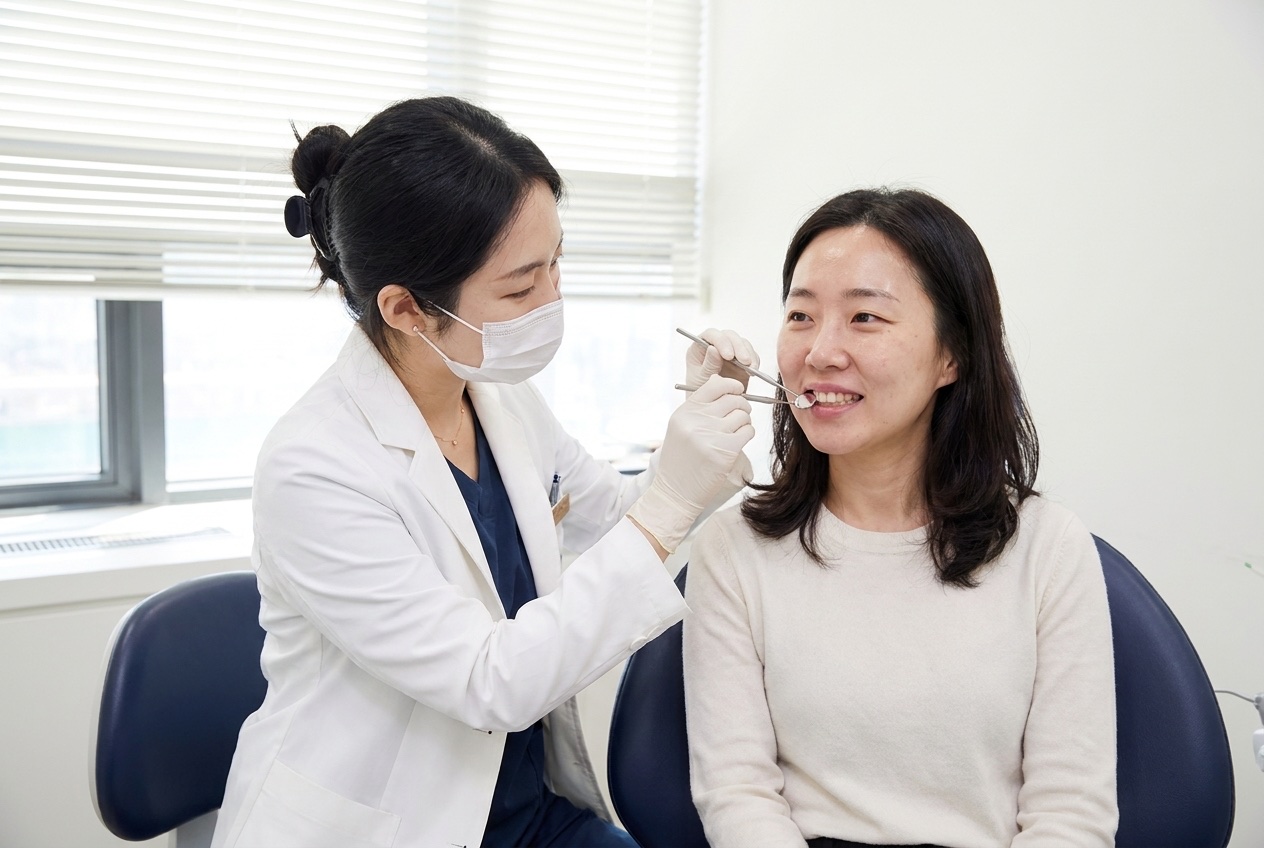
An oral exam and consultation to find out what's causing a gummy smile
Will gum contouring help?
Gum contouring is a good fit for one cause in particular: teeth covered by so much gum that they look unusually short and stubby. The basic idea is to precisely trim back the excess gum covering the teeth so the hidden part of each tooth shows fully. That brings the teeth and gums back into proportion.
In practice, though, some people only need a little gum trimmed, while others also need the bone underneath (the jawbone around the teeth) reshaped. Every tooth needs a certain amount of space between the top of the bone and the crown of the tooth, where the gum attaches, and the body works hard to keep it. Dentists call this the biologic width. If the bone sits too close to the crown and we only cut away gum, the body grows the gum back to restore that space. In other words, it quickly goes back to the way it was.
That's why I take X-rays and do a careful exam before treatment to see exactly where the bone sits. If your mouth is built so that trimming the gums alone is unlikely to relapse, we keep it simple. If the bone position needs adjusting too, I plan a procedure called crown lengthening, which reshapes both the gums and the bone to lower the chance of relapse. Of course, adding bone work means recovery takes longer.
Adding no-prep veneers
Even after gum contouring has given the teeth enough length and evened out the gum line, some patients still aren't happy with the shape or color of the teeth themselves and want to go further. With interest in cosmetic dentistry growing, plenty of patients here in Apgujeong ask whether they can combine treatment like no-prep veneers with gum contouring.
With no-prep veneers, we leave the tooth surface almost untouched, or smooth it only very slightly, and then bond a thin ceramic shell to the front of the tooth. Gum contouring may get the height and width of the teeth into reasonable proportion. But if a tooth has a chipped edge, if the teeth are naturally very small, or if there are small gaps between them, veneers can make the result look more finished.
That said, I don't tell everyone who has gum contouring that they need veneers as well. If gum contouring alone gives you the smile you wanted, there's no reason to add more. Keeping your natural teeth healthy comes first. I bring up veneers carefully, as one option, only when I think the cosmetic improvement is something you really need and would make you much happier with the result.
Swelling and time off work
Patients with jobs mostly want to know two things: how bad the swelling gets, and when they can get back to normal life. Recovery after gum contouring varies a lot depending on how much was done, how your skin and tissue respond, and how quickly you usually heal.
If only the gums were reshaped, you may feel a little sore once the numbness wears off, but usually there's just mild swelling for 2 to 3 days. Most people go back to work the same day or the next day and can talk and get through the workday without trouble. If the procedure included reshaping the bone, as I described above, the swelling can last somewhat longer. We place stitches to protect the area, and they usually come out after 7 to 10 days. Your lips may look a bit puffy during that time, so I recommend putting off important appointments or events. We take great care to keep the procedure as comfortable as possible, but please keep in mind that swelling and discomfort afterward differ from person to person.
Here's a checklist of things to do at home to help you heal well.
- Take your medication: We prescribe antibiotics or pain medication to prevent infection and manage pain. Even if you feel better, take all of it as directed.
- Use a cold compress early on: For about 48 hours starting right after the procedure, hold a cold compress on the outside, over your upper lip and under your nose. It narrows the blood vessels and helps a lot with bringing the swelling down.
- Eat soft foods: For about a week, avoid spicy, salty, hot or otherwise irritating foods. Lukewarm, soft, mostly liquid meals are best.
- Be gentle with oral hygiene: If toothbrush bristles touch the treated area directly, the wound can open up. Don't brush that area. Instead, rinse gently morning and night with the antiseptic mouthwash we prescribe.
- No smoking or drinking: The chemicals in cigarettes and alcohol interfere with blood flow to the gums, which slows healing and can cause inflammation. Please avoid both completely until you've healed.
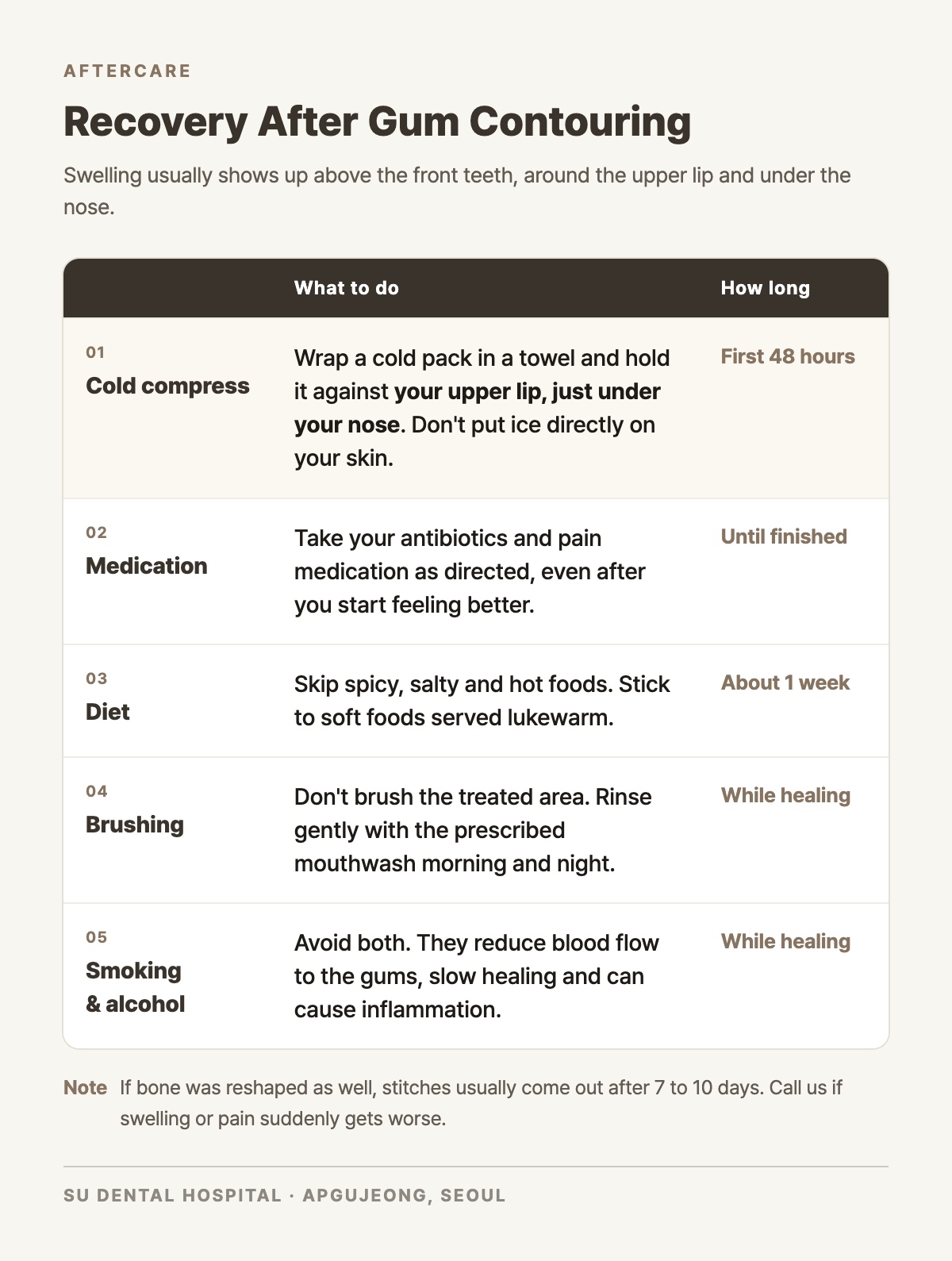
How to use a cold compress to manage swelling, plus other aftercare tips
The bottom line
Showing a bit more gum when you smile is not a disease that has to be treated. If you look in the mirror and see it as part of who you are, and it doesn't get in the way of daily life, you can leave it as it is. It causes no problems for your oral health. But if it keeps you from smiling freely and makes you hold back around people, then I'd suggest coming in for an accurate diagnosis of what's causing it.
We don't give every patient the same treatment. We look closely at your mouth and the structure of the bone around your teeth, leave out any treatment you don't really need, and explain honestly only what's necessary. You don't have to decide anything right away. Stop by when it suits you, talk through what shapes your smile and what your options are, and get a clearer sense of whether you really need this treatment.
Frequently asked questions
Can the gums grow back after gum contouring?
If the space between the crown of the tooth and the bone is too small, the gums can grow back. We use X-rays to see exactly where the bone sits. When needed, we do crown lengthening, which reshapes the bone as well, to lower the chance of relapse.
How is it treated when the lip muscle or jaw is the cause?
If the muscle that pulls up the lip is strong, controlling its movement with something like Botox may be the right approach. If the cause is skeletal, with the upper jaw itself grown long, orthodontic treatment or surgery may be needed, so an accurate diagnosis comes first.
What is recovery like if the bone is reshaped too?
When bone is reshaped, we place stitches to protect the area, and they usually come out after 7 to 10 days. Your lips may be a bit swollen during that time, so recovery takes longer. That's why I recommend putting off important plans if you can.
When does it make sense to add no-prep veneers?
They're worth considering if a tooth has a chipped edge, if the teeth are naturally small, or if there are small gaps between them. Adding veneers can make the result look more finished. We only suggest them as an option when we think the cosmetic improvement is really needed.