Plenty of people who come to see me hold back their smile because of the shape or color of their front teeth. More and more of them have already read up on no-prep veneers in Apgujeong by the time they arrive, usually on a friend's recommendation or after seeing them in the media. A patient I saw a few days ago was one of them. The idea of thin porcelain shells bonded on without any shaving appealed to them, but now that it was time to go ahead, the worries took over. "What if one pops off when I brush a little too hard?" "Will the upkeep be a hassle?" These practical questions come up in my chair more than any others, so let's take them one at a time.
Do no-prep veneers really leave the teeth untouched?
First, not everyone needs this treatment. When there's a small gap between the front teeth or they look uneven, veneers fix the shape by bonding thin ceramic shells to the front surface of the teeth. "No-prep" usually means we skip reshaping the tooth surface altogether, or smooth it only very slightly, by about 0.1–0.3 mm. If your teeth already stick out or are badly crooked, though, adding veneers on top can make your mouth look even more pushed forward. In that case I don't recommend veneers. It's better to deal with the cause first using more conservative options, such as limited orthodontic treatment or teeth whitening.
If you're a good candidate and decide to go ahead, the usual order is this: at the first visit we take an impression of your teeth and design the veneers, and 1–2 weeks later, once the lab has finished them, we bond them on. Because we keep as much of the enamel as possible, there's less sensitivity. But because the veneers are so thin, they need a bit of extra care day to day.
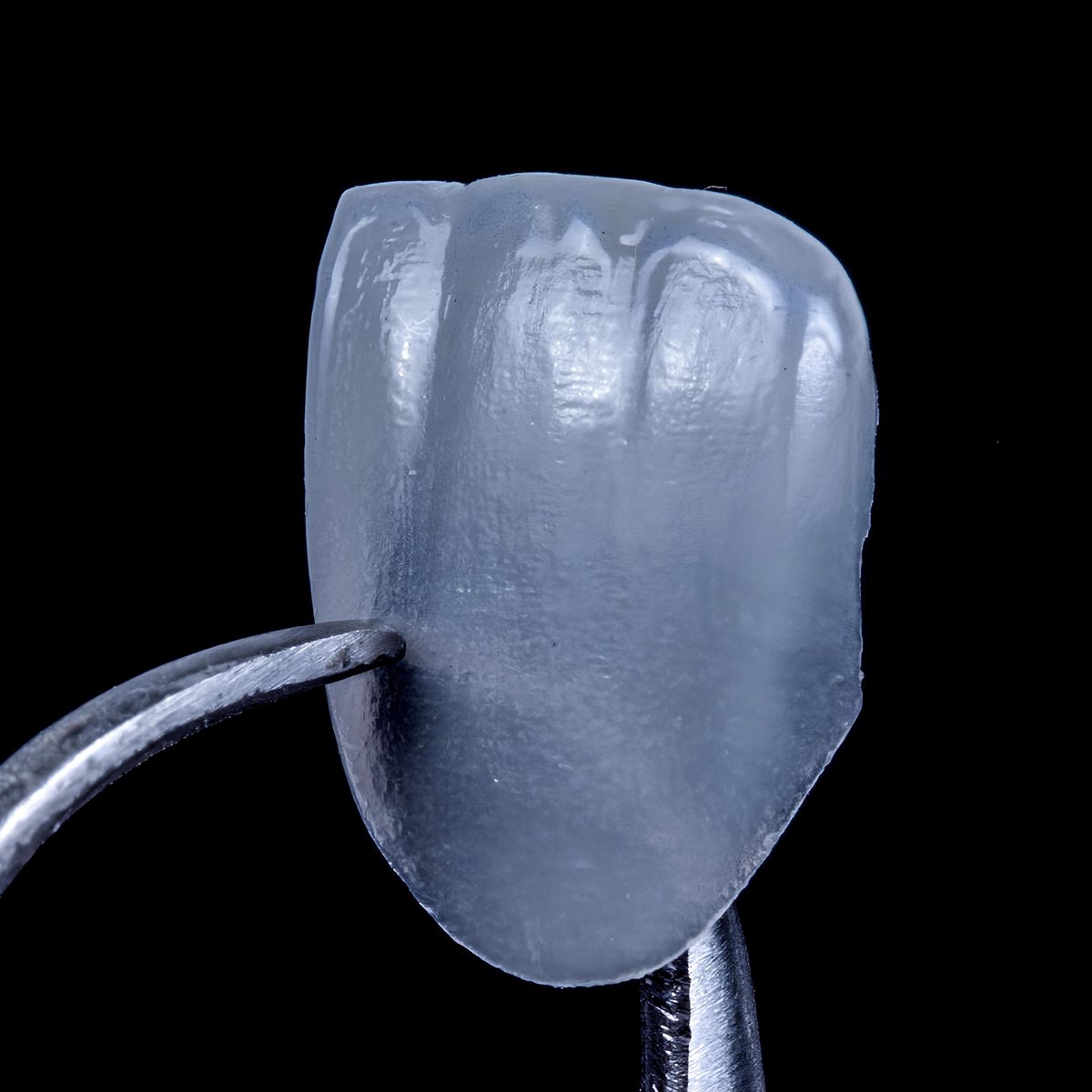
A veneer held in dental cotton pliers, thin enough for light to shine through
Can brushing too hard knock a veneer off?
Patients worry a lot about a veneer coming off or chipping. The short answer: a veneer that was bonded properly and securely won't easily come off just from the pressure of toothbrush bristles. The real issue isn't how hard you brush. It's the direction you brush in and your habits.
The habit to watch out for is scrubbing hard from side to side. Brushing like this day after day puts heavy friction on the gums, and over time they start to recede. As the gums pull back, the edge where your natural tooth meets the veneer becomes exposed. Food debris and bacteria can collect in that tiny gap and cause decay underneath. In the end, decay and inflammation that seep in under the bonded surface weaken the bond, and that's a major reason veneers come off. Guidance from groups such as the Korean Academy of Prosthodontics also stresses that keeping the edge between the gum and the restoration clean matters more than anything for making it last.
What should I be careful about when brushing and day to day?
Veneers last longest when you treat them a little more gently than natural teeth. Pick a toothbrush with soft, fine bristles rather than stiff ones. When you brush, rest the bristles lightly at a 45-degree angle where the tooth meets the gum, then sweep gently up or down from the gum toward the biting edge. This is called the roll technique or the modified Bass technique, and it removes plaque along the edge well without straining the gums.
Your choice of toothpaste matters too. Some toothpastes that advertise whitening or leave a squeaky-clean feel contain a lot of coarse abrasives. Used for a long time, they can leave fine scratches on the porcelain, dulling its shine and letting stains settle into those scratches. A short list for your daily routine:
- Use a gentle toothpaste with low abrasive content
- Brush with a soft, fine-bristled toothbrush, sweeping from the gum toward the tooth
- Don't bite down hard on ice, hard candy, nuts or other hard or chewy foods with your front teeth
- When using floss or an interdental brush, don't pull in a way that pries the veneer's edge up from the gum side
- After dark-colored drinks that can stain, rinse your mouth lightly with water
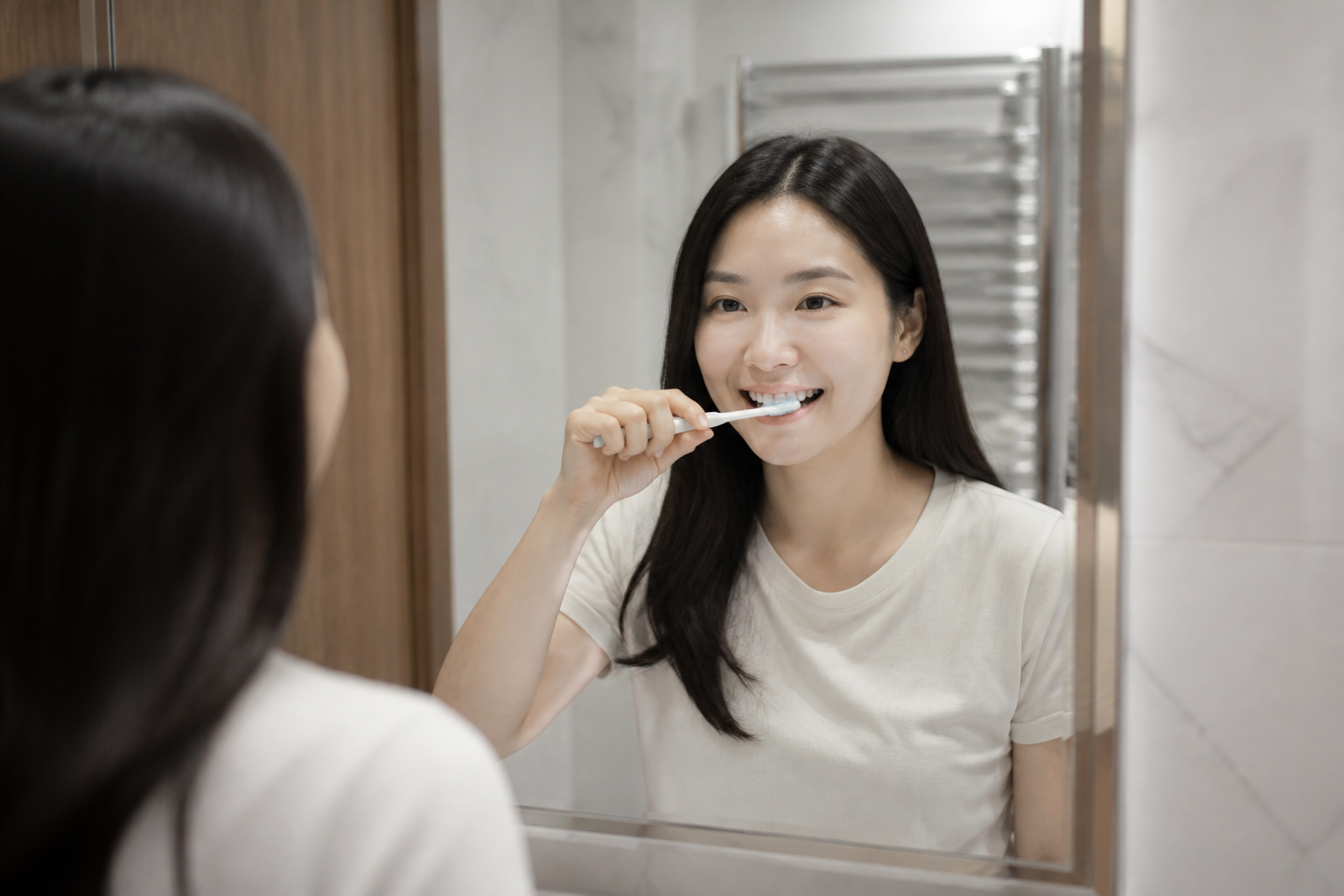
Brushing carefully in front of a mirror, right up to the front surfaces of the teeth
Should I tell the staff about my veneers before a cleaning?
Yes, please let the staff know ahead of time. The ultrasonic scaler most dental offices use for professional cleaning (scaling) breaks tartar loose with fast, tiny vibrations. If its tip hits the edge or margin of a thin porcelain veneer hard and directly, it can cause small fractures or damage the surface. If you tell us beforehand which teeth have veneers, we can remove the tartar carefully with hand instruments or turn down the vibration so the cleaning is done safely.
The Korea Disease Control and Prevention Agency's National Health Information Portal explains in its guidance on dental restorations that even though average figures exist for how long restorations last, the actual lifespan varies a great deal depending on the patient's own oral hygiene and eating habits. No restoration lasts forever, however precisely it's made. That's why, even after treatment is finished, you need a checkup every 6 months to 1 year so we can check the bond and the health of your gums.
A few last words
In long conversations with patients, I often find their fear of side effects is as strong as their hope for a better look. What matters most isn't chasing whatever treatment is trending. It's sitting down with your dentist and looking honestly at whether your teeth and bite actually need this treatment, and whether there are other options. Rather than rushing into treatment, I'd encourage you to take your time and decide once you fully understand the pros and cons.
If you already have veneers or other restorations, don't put off coming in if you notice an edge that catches sharply on the tip of your tongue or your fingernail while brushing, or if one spot keeps feeling sensitive when you drink cold water. It can be a sign that some of the bonding cement has washed out and left a tiny gap, or that gum inflammation is starting. Results and how long they last can vary from person to person, depending on your mouth and your daily habits. Instead of planning more treatment than you need, rely on good care and regular checkups to keep your smile comfortable and healthy for years.
Frequently asked questions
How long does getting no-prep veneers take?
At our clinic, treatment usually takes two visits. At the first visit we take an impression of your teeth and design the veneers, and 1–2 weeks later, once the lab has finished them, we bond them safely to your teeth.
Can I get veneers if my teeth are very crooked?
If your teeth are badly crooked or stick out, adding veneers can make your mouth look even more pushed forward. In those cases, we recommend limited orthodontic treatment or whitening first rather than veneers.
Can I floss as usual after getting veneers?
You can use floss or an interdental brush, but pay attention to the direction. Pulling in a way that pries the veneer's edge up from the gum side can make it come off, so please be careful.
How often should I come in for checkups after treatment?
To keep your veneers healthy, it's best to visit us every 6 months to 1 year. At these checkups we look closely at how well the veneers are bonded and at the health of the gums around them.